# Range
Last updated:
October 18, 2026
\| 5 minutes read
* UIKit / SwiftUI
This example demonstrates how to use **GEMKit** in a UIKit application to display multiple maps simultaneously.
Check the full implementation on [GitHub](https://github.com/magiclane/magiclane-maps-sdk-examples-for-ios/tree/main/UIKit/3DScene/RangeView).
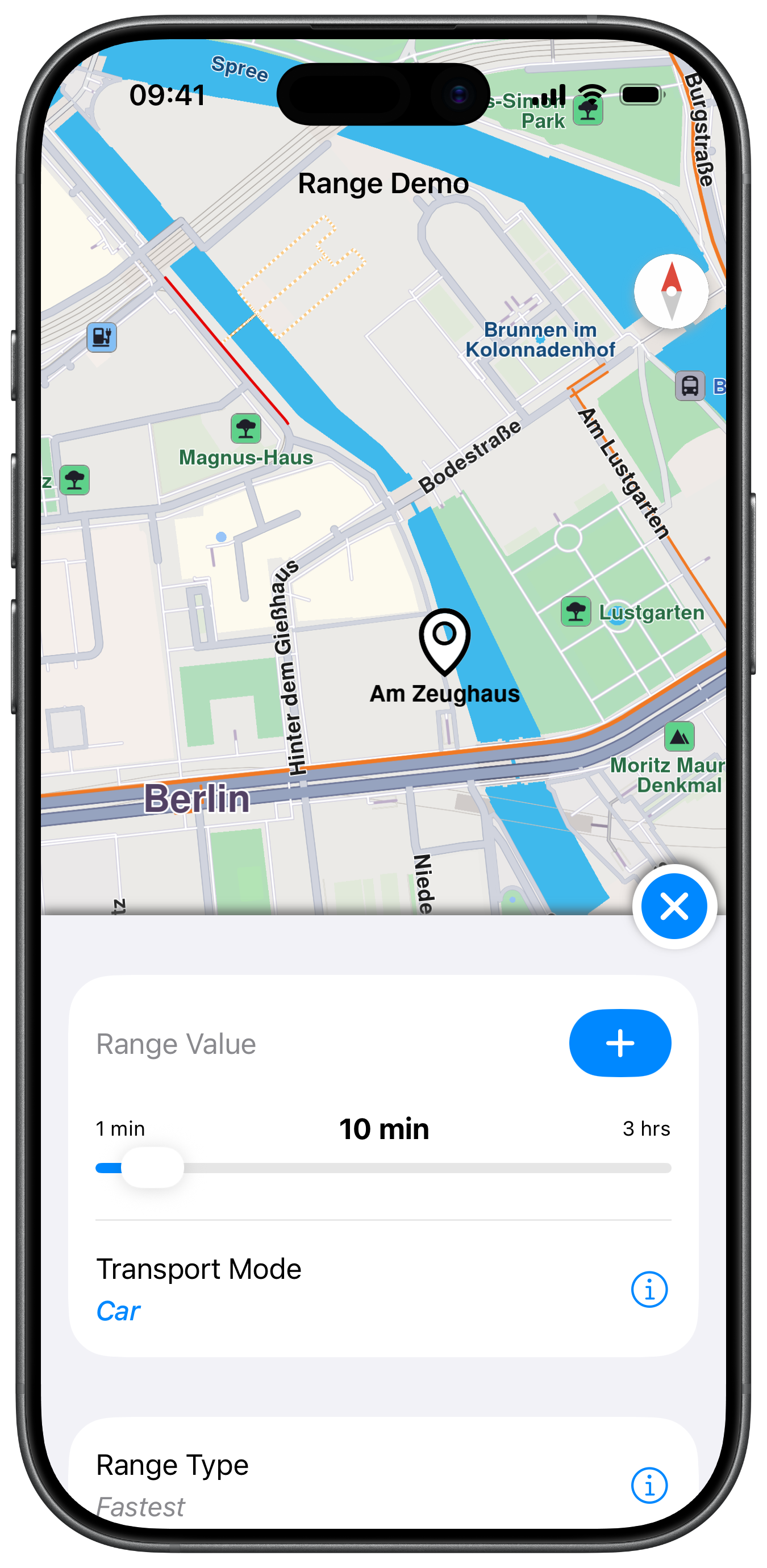
**Range View with Settings**
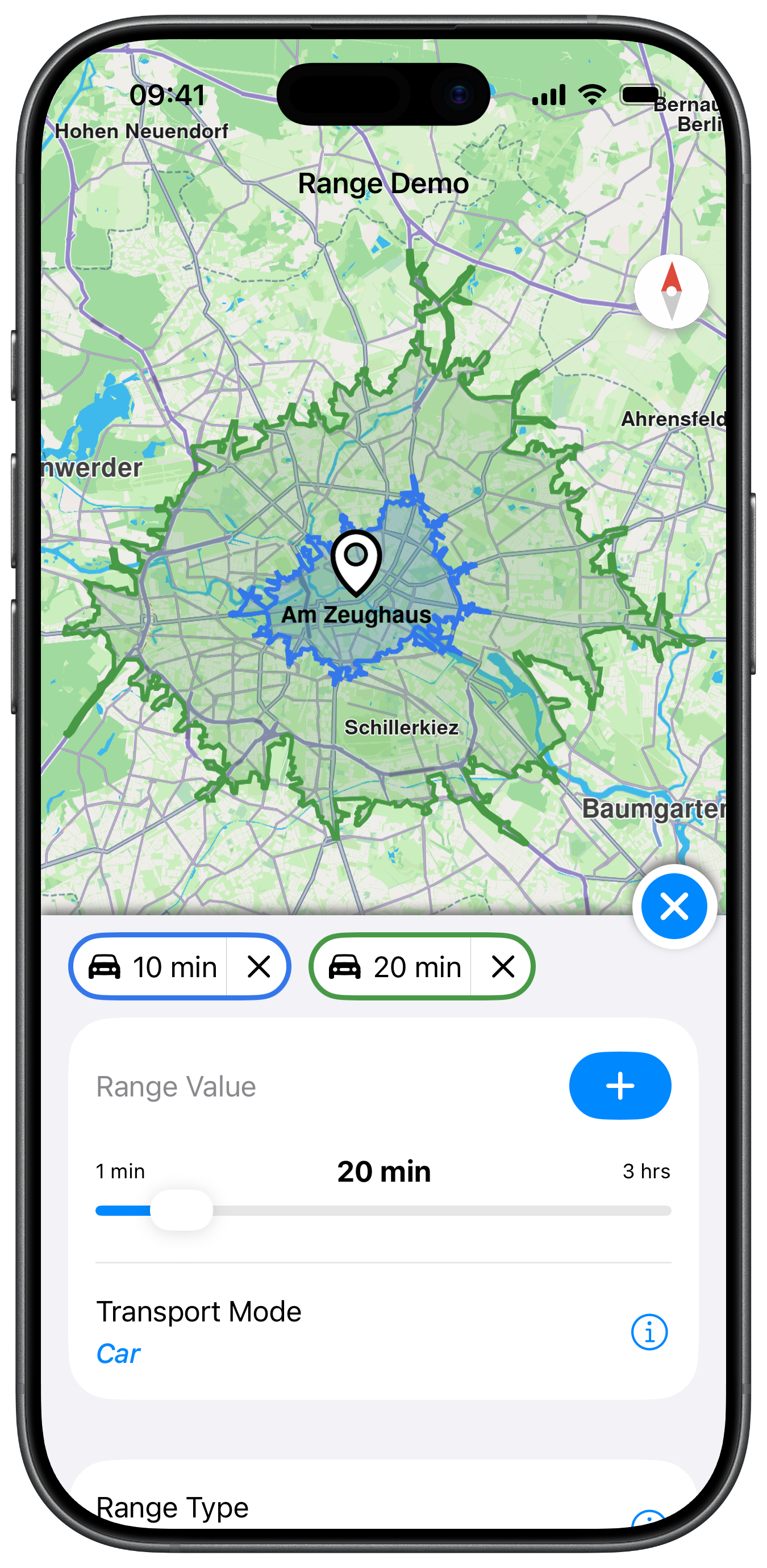
**Calculated Ranges on Map**
### Map Display and Range View Preparation[](#map-display-and-range-view-preparation "Direct link to Map Display and Range View Preparation")
The following code outlines the main view, which displays the map and prepares the range calculation view:
ViewController.swift[View on GitHub](https://github.com/magiclane/magiclane-maps-sdk-examples-for-ios/tree/main/UIKit/3DScene/RangeView/RangeView/ViewController.swift)
```swift
class ViewController: UIViewController, MapViewControllerDelegate {
var mapViewController: MapViewController?
var rangeViewController: RangeViewController?
var buttonExit: UIButton?
deinit {
if let controller = mapViewController {
controller.destroy()
}
}
override func viewDidLoad() {
super.viewDidLoad()
if let navigationController = self.navigationController {
let appearance = navigationController.navigationBar.standardAppearance
navigationController.navigationBar.scrollEdgeAppearance = appearance
}
self.title = "Range Demo"
self.createMapView()
}
override func viewWillAppear(_ animated: Bool) {
super.viewWillAppear(animated)
self.mapViewController!.startRender()
}
override func viewDidAppear(_ animated: Bool) {
super.viewDidAppear(animated)
let location = CoordinatesObject.coordinates(withLatitude: 52.517477, longitude: 13.397152) // Berlin
self.mapViewController!.center(onCoordinates: location, zoomLevel: 70, animationDuration: 0)
}
override func viewWillDisappear(_ animated: Bool) {
super.viewWillDisappear(animated)
self.mapViewController!.stopRender()
}
// MARK: - Map View
func createMapView() {
self.mapViewController = MapViewController.init()
self.mapViewController!.delegate = self
self.mapViewController!.view.backgroundColor = UIColor.systemBackground
self.addChild(self.mapViewController!)
self.view.addSubview(self.mapViewController!.view)
self.mapViewController!.didMove(toParent: self)
self.mapViewController!.view.translatesAutoresizingMaskIntoConstraints = false
NSLayoutConstraint.activate([
self.mapViewController!.view.topAnchor.constraint(equalTo: self.view.topAnchor, constant: 0),
self.mapViewController!.view.leadingAnchor.constraint(equalTo: self.view.leadingAnchor, constant: 0),
self.mapViewController!.view.bottomAnchor.constraint(equalTo: self.view.bottomAnchor, constant: -0),
self.mapViewController!.view.trailingAnchor.constraint(equalTo: self.view.trailingAnchor, constant: -0)
])
}
// MARK: - TableView
func addRangeView() {
let rangeViewController = RangeViewController.init(mapViewController: self.mapViewController!)
rangeViewController.view.layer.shadowColor = UIColor.darkGray.cgColor
rangeViewController.view.layer.shadowOpacity = 0.8
self.view.addSubview(rangeViewController.view)
rangeViewController.view.translatesAutoresizingMaskIntoConstraints = false
NSLayoutConstraint.activate([
rangeViewController.view!.leadingAnchor.constraint(equalTo: self.view.leadingAnchor),
rangeViewController.view!.trailingAnchor.constraint(equalTo: self.view.trailingAnchor),
rangeViewController.view!.bottomAnchor.constraint(equalTo: self.view.bottomAnchor),
rangeViewController.view!.heightAnchor.constraint(equalToConstant: 360)
])
let size: CGFloat = 50
let buttonExit = UIButton.init(type: .system)
buttonExit.setImage(
UIImage.init(systemName: "xmark.circle.fill", withConfiguration: UIImage.SymbolConfiguration(pointSize: 30, weight: .medium)),
for: .normal)
buttonExit.addTarget(self, action: #selector(closeRangeView), for: .touchUpInside)
buttonExit.layer.shadowColor = UIColor.darkGray.cgColor
buttonExit.layer.shadowOpacity = 0.8
buttonExit.backgroundColor = UIColor.systemBackground
buttonExit.layer.cornerRadius = size / 2
self.buttonExit = buttonExit
self.view.addSubview(buttonExit)
buttonExit.translatesAutoresizingMaskIntoConstraints = false
NSLayoutConstraint.activate([
buttonExit.trailingAnchor.constraint(equalTo: self.view.trailingAnchor, constant: -5),
buttonExit.bottomAnchor.constraint(equalTo: rangeViewController.view!.topAnchor, constant: size - 30),
buttonExit.widthAnchor.constraint(equalToConstant: size),
buttonExit.heightAnchor.constraint(equalToConstant: size)
])
self.rangeViewController = rangeViewController
}
```
### Range View Actions[](#range-view-actions "Direct link to Range View Actions")
The following code outlines the main functions to handle the range view actions, such as closing the view and handling the range operations, including adding, deleting, and selecting range routes:
info
For this example the Range UI that shows the different route settings and range actions is done in a SwiftUI View for the sake of simplicity. You can find the full implementation of the `RangeView` in the GitHub repository linked above.
RangeViewController.swift[View on GitHub](https://github.com/magiclane/magiclane-maps-sdk-examples-for-ios/tree/main/UIKit/3DScene/RangeView/RangeView/RangeViewController.swift)
```swift
func prepareView() {
guard let mapViewController = self.mapViewController else { return }
self.rangeView = RangeView(model: self.model)
self.rangeView!.didSelectOptionItem = { [weak self] item in
guard let strongSelf = self else { return }
guard let rangeView = strongSelf.rangeView else { return }
let alert = strongSelf.presentOptionsMenu(
title: item.title,
options: item.options,
selectedIndex: item.chosenOption
) { newIndex in
rangeView.updateSettingsOnOption(item: item, newOption: newIndex)
}
if let alert = alert {
strongSelf.present(alert, animated: true, completion: nil)
}
}
self.rangeView!.didSelectTransportMode = { [weak self] in
guard let strongSelf = self else { return }
guard let rangeView = strongSelf.rangeView else { return }
let alert = strongSelf.presentOptionsMenu(
title: "Transport Mode",
options: [
"Car",
"Pedestrian",
"Bicycle",
"Truck"
],
selectedIndex: strongSelf.model.mode.rawValue
) { newIndex in
if strongSelf.model.mode.rawValue != newIndex {
rangeView.updateTransportModeOnOption(newOption: newIndex)
}
}
if let alert = alert {
strongSelf.present(alert, animated: true, completion: nil)
}
}
self.rangeView!.onRangeAdded = { [weak self] in
guard let strongSelf = self else { return }
if strongSelf.model.isRangeValueUsed(value: strongSelf.model.rangeValue, transportMode: strongSelf.model.mode) == false {
strongSelf.calculateRangeRoutes()
}
}
self.rangeView!.onRangeDeleted = { [weak self] item in
guard let strongSelf = self else { return }
mapViewController.removeRoutes(item.routes)
strongSelf.colors[item.routeColor] = false
strongSelf.centerOnRoutes(routes: strongSelf.model.getSelectedRangeRoutes())
}
self.rangeView!.onRangeSelected = { [weak self] item in
guard self != nil else { return }
if item.isSelected {
// let insets = strongSelf.calculateAreaInset(margin: 10)
// mapViewController.setEdgeAreaInsets(insets)
mapViewController.presentRoutes(item.routes, withTraffic: nil, showSummary: false, animationDuration: 200)
// mapViewController.setDebugEdgeAreaVisible(true)
if let route = item.routes.first {
let renderSettings = MapViewRouteRenderSettings.init()
renderSettings.options = Int32(MapViewRouteRenderOption.main.rawValue)
renderSettings.fillColor = item.routeColor
renderSettings.contourInnerSize = 0.3
renderSettings.contourOuterSize = 0.3
let preferences = mapViewController.getPreferences()
preferences.setRenderSettings(renderSettings, route: route)
}
} else {
mapViewController.removeRoutes(item.routes)
}
}
let controller = UIHostingController.init(rootView: self.rangeView!)
self.addChild(controller)
self.view.addSubview(controller.view)
controller.didMove(toParent: self)
controller.view.translatesAutoresizingMaskIntoConstraints = false
let array: [NSLayoutConstraint] = [
controller.view.topAnchor.constraint(equalTo: self.view.topAnchor, constant: 0),
controller.view.leadingAnchor.constraint(equalTo: self.view.leadingAnchor, constant: 0),
controller.view.trailingAnchor.constraint(equalTo: self.view.trailingAnchor, constant: -0),
controller.view.bottomAnchor.constraint(equalTo: self.view.bottomAnchor, constant: -0)
]
NSLayoutConstraint.activate(array)
controller.view.backgroundColor = .systemBackground
}
```
### Range Calculation[](#range-calculation "Direct link to Range Calculation")
The following code demonstrates how to calculate the range based on the selected settings in the range view and present the results on the map:
RangeViewController.swift[View on GitHub](https://github.com/magiclane/magiclane-maps-sdk-examples-for-ios/tree/main/UIKit/3DScene/RangeView/RangeView/RangeViewController.swift)
```swift
// MARK: - Draw Routes
func calculateRangeRoutes() {
guard let mapViewController = self.mapViewController else { return }
guard let rangeLandmark = landmark else { return }
let value = NSNumber.init(value: model.rangeType == .time ? Int(model.rangeValue) * 60 : Int(model.rangeValue))
let routePreferences = self.getRoutePreferences(transportMode: model.mode)
//Range value setting for the route calculation.
routePreferences.setRouteRanges([value], quality: 100)
self.navigationContext = NavigationContext.init(preferences: routePreferences)
self.model.isCalculating = true
self.navigationContext.calculateRoute(
withWaypoints: [rangeLandmark],
completionHandler: { [weak self] (results: [RouteObject]) in
guard let strongSelf = self else { return }
strongSelf.model.isCalculating = false
if !results.isEmpty, let route = results.first {
let rangeRouteItem = RangeValueRoutesItem(
rangeType: strongSelf.model.rangeType, rangeValue: strongSelf.model.rangeValue, routes: [route],
transportMode: strongSelf.model.mode)
strongSelf.model.addPresentedRoutes(rangeRouteItem)
let color: UIColor =
strongSelf.model.presentedRoutes.count > 1
? (strongSelf.colors.someKey(forValue: false) ?? strongSelf.initialColor) : strongSelf.initialColor
// let insets = strongSelf.calculateAreaInset(margin: 10)
// mapViewController.setEdgeAreaInsets(insets)
mapViewController.presentRoutes(results, withTraffic: nil, showSummary: false, animationDuration: 800)
// mapViewController.setDebugEdgeAreaVisible(true)
rangeRouteItem.routeColor = color
strongSelf.colors[color] = true
let renderSettings = MapViewRouteRenderSettings.init()
renderSettings.options = Int32(MapViewRouteRenderOption.main.rawValue)
renderSettings.fillColor = color
renderSettings.contourInnerSize = 0.3
renderSettings.contourOuterSize = 0.3
let preferences = mapViewController.getPreferences()
preferences.setRenderSettings(renderSettings, route: route)
}
})
}
```