Range Finder
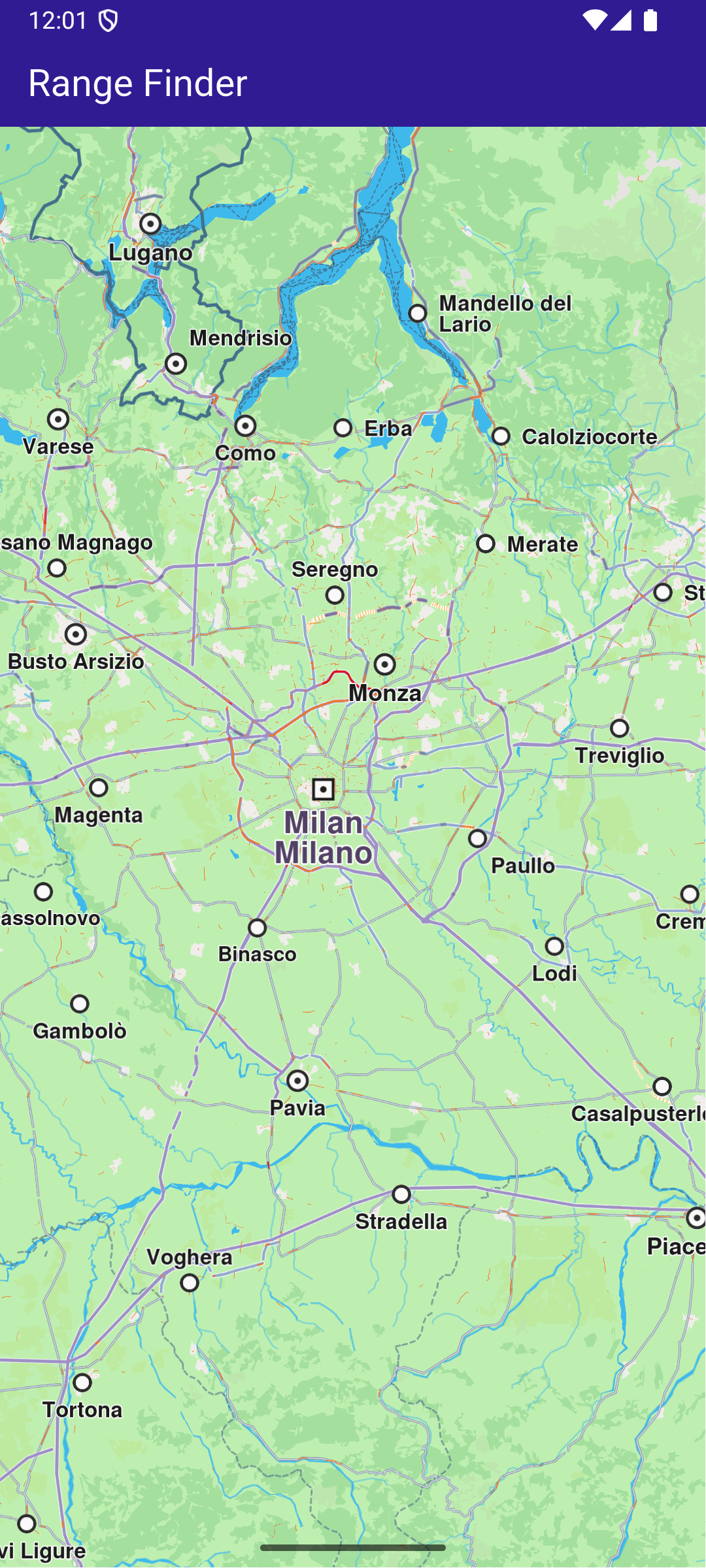
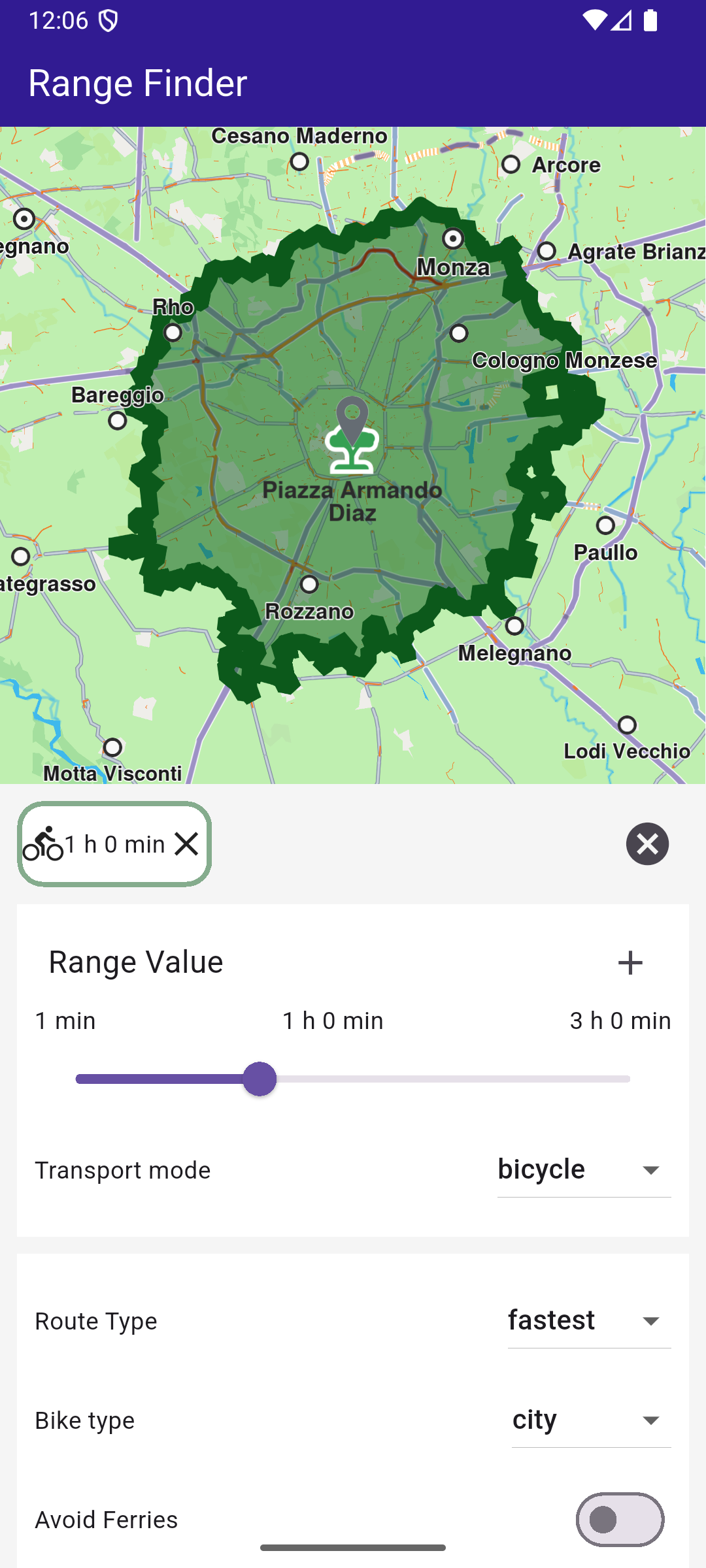
In this guide, you will learn how to implement route range calculation from a Point of Interest (POI) using the Maps SDK for Flutter. This example demonstrates how to display a map, tap on a landmark, and calculate route ranges based on different transport modes and preferences.
How it Works
This example demonstrates the following features:
- Allow users to interact with a map by tapping landmarks to focus on specific Points of Interest (POIs).
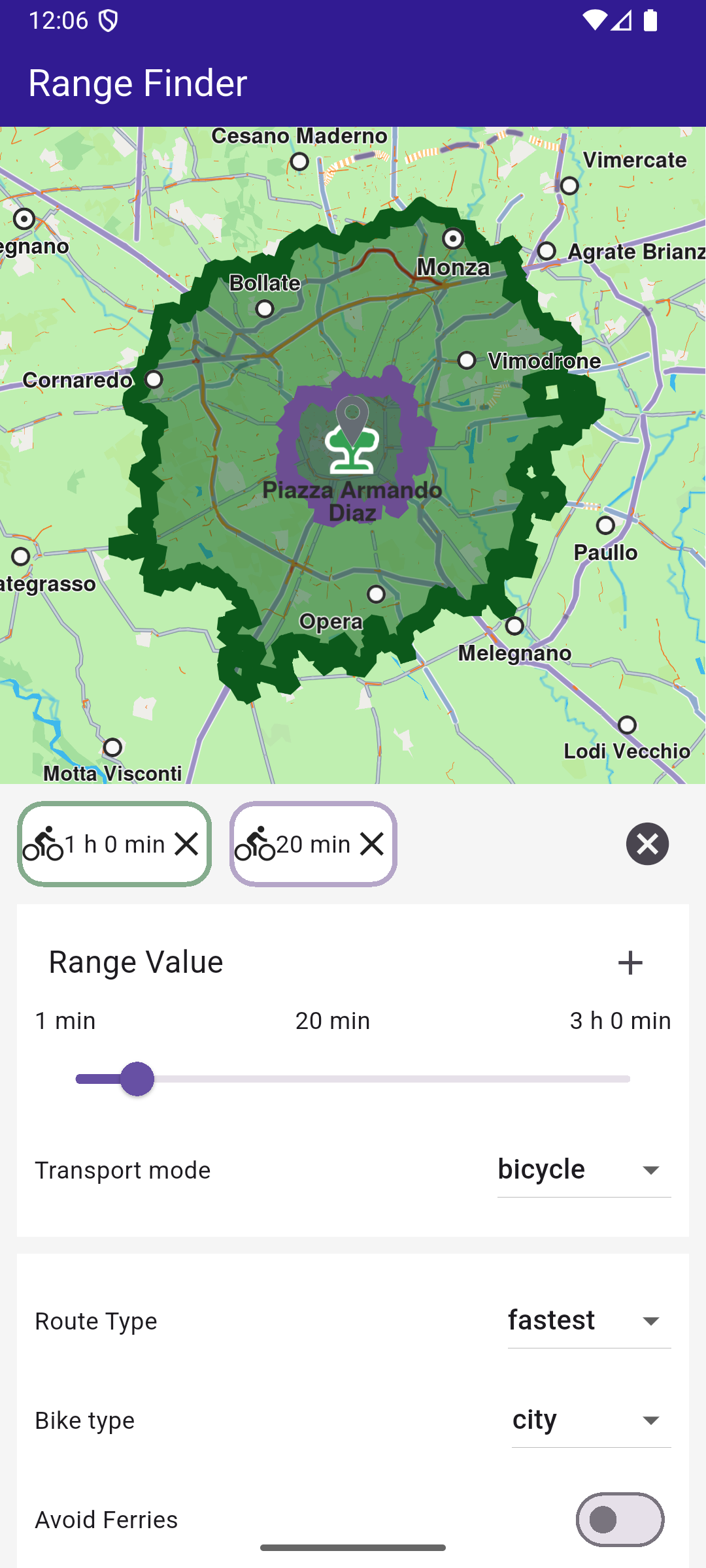
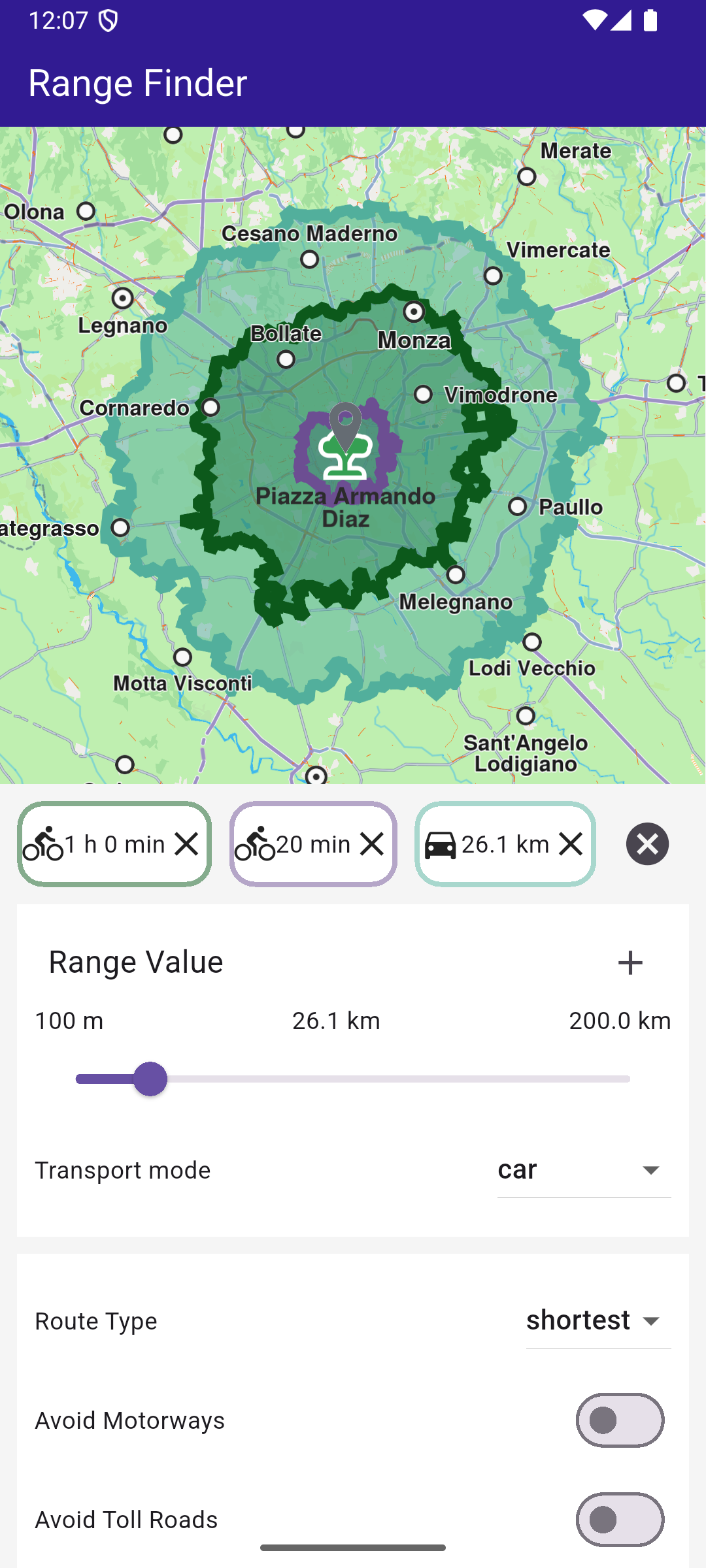
- Perform route range calculations from selected POIs using preferences such as transport mode.
UI and Map Integration
The following code creates a user interface featuring a GemMap widget and an app bar. When a Point of Interest (POI) is selected on the map, a range finder panel appears at the bottom of the screen.
Define the main application widget, MyApp.
class MyApp extends StatelessWidget {
const MyApp({super.key});
Widget build(BuildContext context) {
return const MaterialApp(
debugShowCheckedModeBanner: false,
title: 'Range Finder',
home: MyHomePage(),
);
}
}
class MyHomePage extends StatefulWidget {
const MyHomePage({super.key});
State<MyHomePage> createState() => _MyHomePageState();
}
Within _MyHomePageState , define the necessary state variables and methods to interact with the map and manage routes.
class _MyHomePageState extends State<MyHomePage> {
late GemMapController _mapController;
Landmark? _focusedLandmark;
void dispose() {
GemKit.release();
super.dispose();
}
Widget build(BuildContext context) {
return Scaffold(
appBar: AppBar(
toolbarHeight: 50,
backgroundColor: Colors.deepPurple[900],
title: const Text(
'Range Finder',
style: TextStyle(color: Colors.white),
),
),
body: Stack(
children: [
GemMap(
key: ValueKey("GemMap"),
onMapCreated: _onMapCreated,
appAuthorization: projectApiToken,
),
if (_focusedLandmark != null)
Align(
alignment: Alignment.bottomCenter,
child: RangesPanel(
onCancelTap: _onCancelLandmarkPanelTap,
landmark: _focusedLandmark!,
mapController: _mapController,
),
),
],
),
);
}
// The callback for when map is ready to use.
Future<void> _onMapCreated(GemMapController controller) async {
// Save controller for further usage.
_mapController = controller;
// Register route tap gesture callback.
await _registerLandmarkTapCallback();
}
Future<void> _registerLandmarkTapCallback() async {
_mapController.registerOnTouch((pos) async {
// Select the object at the tap position.
await _mapController.setCursorScreenPosition(pos);
// Get the selected landmarks.
final landmarks = _mapController.cursorSelectionLandmarks();
// Reset the cursor position back to middle of the screen
await _mapController.resetMapSelection();
// Check if there is a selected Landmark.
if (landmarks.isEmpty) {
return;
}
// Highlight the selected landmark.
_mapController.activateHighlight(landmarks);
final lmk = landmarks[0];
setState(() {
_focusedLandmark = lmk;
});
// Use the map controller to center on coordinates.
_mapController.centerOnCoordinates(
lmk.coordinates,
zoomLevel: 70,
screenPosition: Point<int>(
_mapController.viewport.width ~/ 2,
_mapController.viewport.height ~/ 3,
),
);
});
}
void _onCancelLandmarkPanelTap() {
// Remove landmark highlights from the map.
_mapController.deactivateAllHighlights();
_mapController.preferences.routes.clear();
setState(() {
_focusedLandmark = null;
});
}
}
Range Calculation and Preferences
The RangesPanel widget handles the UI and logic for calculating and displaying route ranges. Here are the critical parts:
Define State Variables
Define state variables to hold user preferences and the calculated route ranges.
class _RangesPanelState extends State<RangesPanel> {
  int _rangeValue = 3600;
  RouteTransportMode _transportMode = RouteTransportMode.car;

  RouteType _routeType = RouteType.fastest;
  bool _avoidMotorways = false;
  bool _avoidTollRoads = false;
  bool _avoidFerries = false;
  bool _avoidUnpavedRoads = false;

  BikeProfile _bikeProfile = BikeProfile.city;
  double _hillsValue = 0;
Calculate Route Ranges
Use the RoutingService to calculate route ranges based on user preferences.
  void _onAddRouteRangeButtonPressed(BuildContext context) {
    if (!_doesRouteRangeExist()) {
      _showSnackBar(context, message: "The route is being calculated.");

      // Calling the calculateRoute SDK method.
      // (err, results) - is a callback function that gets called when the route computing is finished.
      // err is an error enum, results is a list of routes.
      RoutingService.calculateRoute([widget.landmark], _getRoutePreferences(), (
        err,
        routes,
      ) {
        ScaffoldMessenger.of(context).clearSnackBars();

        // If there aren't any errors, we display the range.
        if (err == GemError.success) {
          // Get the routes collection from map preferences.
          final routesMap = widget.mapController.preferences.routes;

          // Color the range in a random color.
          final randomColor = Color.fromARGB(
            128,
            Random().nextInt(200),
            Random().nextInt(200),
            Random().nextInt(200),
          );
          RouteRenderSettings settings = RouteRenderSettings(
            fillColor: randomColor,
          );

          // Display the range on map.
          routesMap.add(routes.first, true, routeRenderSettings: settings);

          // Center the camera on range.
          _centerOnRouteRange(routes.first);

          setState(() {
            _addNewRouteRange(routes.first, randomColor);
          });
        }
      });

      setState(() {});
    }
  }
Define Route Preferences
Create a method to build route preferences based on user inputs.
  RoutePreferences _getRoutePreferences() {
    // Get the preferences based on the selected transport mode.
    switch (_transportMode) {
      case RouteTransportMode.car:
        return RoutePreferences(
          avoidMotorways: _avoidMotorways,
          avoidTollRoads: _avoidTollRoads,
          avoidFerries: _avoidFerries,
          avoidUnpavedRoads: _avoidUnpavedRoads,
          transportMode: _transportMode,
          routeType: _routeType,
          routeRanges: [_rangeValue],
        );
      case RouteTransportMode.lorry:
        return RoutePreferences(
          avoidMotorways: _avoidMotorways,
          avoidTollRoads: _avoidTollRoads,
          avoidFerries: _avoidFerries,
          avoidUnpavedRoads: _avoidUnpavedRoads,
          transportMode: _transportMode,
          routeType: _routeType,
          routeRanges: [_rangeValue],
          avoidTraffic: _trafficAvoidance,
        );
      case RouteTransportMode.pedestrian:
        return RoutePreferences(
          avoidFerries: _avoidFerries,
          avoidUnpavedRoads: _avoidUnpavedRoads,
          transportMode: _transportMode,
          routeRanges: [_rangeValue],
        );
      case RouteTransportMode.bicycle:
        return RoutePreferences(
          avoidFerries: _avoidFerries,
          avoidUnpavedRoads: _avoidUnpavedRoads,
          transportMode: _transportMode,
          routeType: _routeType,
          routeRanges: [_rangeValue],
          bikeProfile: BikeProfileElectricBikeProfile(
            profile: _bikeProfile,
            eProfile: ElectricBikeProfile(),
          ),
        );
      default:
        return RoutePreferences();
    }
  }
Handle User Interactions
Methods to manage user interactions, such as deleting, toggling, and centering on route ranges.
  void _deleteRouteRange(int index) {
    // Remove the route range from map.
    widget.mapController.preferences.routes.remove(routeRanges[index].route);
    setState(() {
      routeRanges.removeAt(index);
    });
  }

  void _toggleRouteRange(int index) {
    if (routeRanges[index].isEnabled) {
      // If the route range is enabled, remove it from map.
      widget.mapController.preferences.routes.remove(routeRanges[index].route);
      return;
    } else {
      // If the route range is disabled, display it on map and center on it.
      RouteRenderSettings settings = RouteRenderSettings(
        fillColor: routeRanges[index].color,
      );
      widget.mapController.preferences.routes.add(
        routeRanges[index].route,
        true,
        routeRenderSettings: settings,
      );
      _centerOnRouteRange(routeRanges[index].route);
    }
  }

  String _getRouteRangeValueString() {
    final String valueString = (_routeType == RouteType.fastest)
        ? convertDuration(_rangeValue)
        : (_routeType == RouteType.economic)
        ? convertWh(_rangeValue)
        : convertDistance(_rangeValue);
    return valueString;
  }

  bool _doesRouteRangeExist() {
    bool exists = routeRanges.any(
      (range) =>
          range.transportMode == _transportMode &&
          range.value == _getRouteRangeValueString(),
    );
    return exists;
  }

  void _addNewRouteRange(Route route, Color color) {
    Range newRange = Range(
      route: route,
      color: color,
      transportMode: _transportMode,
      value: _getRouteRangeValueString(),
      isEnabled: true,
    );
    routeRanges.add(newRange);
  }

  void _centerOnRouteRange(Route route) {
    const appbarHeight = 50;
    const padding = 20;

    // Use the map controller to center on route above the panel.
    widget.mapController.centerOnRoute(
      route,
      screenRect: Rectangle<int>(
        0,
        (appbarHeight + padding * MediaQuery.of(context).devicePixelRatio)
            .toInt(),
        (MediaQuery.of(context).size.width *
                MediaQuery.of(context).devicePixelRatio)
            .toInt(),
        ((MediaQuery.of(context).size.height / 2 -
                    appbarHeight -
                    2 * padding * MediaQuery.of(context).devicePixelRatio) *
                MediaQuery.of(context).devicePixelRatio)
            .toInt(),
      ),
    );
  }

  // Show a snackbar indicating that the route calculation is in progress.
  void _showSnackBar(
    BuildContext context, {
    required String message,
    Duration duration = const Duration(hours: 1),
  }) {
    final snackBar = SnackBar(content: Text(message), duration: duration);

    ScaffoldMessenger.of(context).showSnackBar(snackBar);
  }
You can start calculating a range by tapping the + button after adjusting your specifications for the routes.